Monday, May 9, 2011

Comedians and High Heels in Lagos

If the average Nigerian church service takes 3 hours, it's no surprise that the entertainment show that I attended last night in Lagos started at 6pm and still wasn't anywhere near finished by 11.30. Nor did I realize that I was signing up to watch this production alongside no less than 5000 other people. Literally.

People streamed in for the first hour of the show…and continued to stream in for the second. More chairs were brought in. Staircases were filled. Health and Safety in Britain certainly wouldn’t have approved, but that is of little relevance because the comedians had the thousands-strong audience virtually comatose with laughter. Chairs shaking and thumping. Howling with mirth. Twas a huge pity my Pidgin wasn’t up to it. The general topics were, of course, the familiar friends of people across the continent: police violence; corruption; incompetent politicians; and a fair amount of demeaning commentary about women. All this was interspersed with dancing, lip syncing, more dancing, hotpants…and the 8-year old Nigerian version of Justin Bieber.

Other observations: there is no rhyme or reason to Nigerian fashion. The dresses and styles amongst the audience were allsorts. The take away messages from the Lagosian women were, rather: don’t be shy about your curves…and wear 5-inch heels as often as possible. And if you need to hop on the back of a motorbike in a miniskirt, just get on with it. I can safely say that I haven’t been to any other African country where such extensive exposure of skin appears to be considered pretty normal among the middle classes.

On attempting to leave, and having passed the Rolls Royce, the Hummer and the guy with the automatic rifle at the front door, we found that we’d been parked in. My initial suggestion to drive through the hotel flower bed was shunned, but not for long, once seven versions of an eight-point turn had failed. The flowers turned out more or less fine.

Back at the fancy hotel, I enjoy air-conditioning, running water and satellite television. My window is all steamed up on the outside with the Lagos humidity that I can’t feel on the inside because I’m so privileged, but two hundred metres away is a small shanty settlement. Motorbikes, dust, dirt, open fires, certainly no sanitation. A whole different world.

The average private property in this part of town apparently costs $3 million dollars. That’s Lagos square-metres for you. It must be virtually impossible for a young person, even a very well paid one, to get onto the property ladder. As for rental, you have to pay at least a year’s rent up front in advance, if not two. You’re likely to still have to commute 2 hours to work. One of my colleagues has to leave home at 5.15am if he wants to spend 20 - rather than 120 - minutes on the road.

Departure Day: Thankfully this time I didn’t travel Mugabe-style to the airport. We spent two and a quarter hours with broken air-con in heavy traffic and fumes. And once at the airport, we all queued for a single X-ray scanner, so that was another 90 minutes.

One of the security officials made an announcement to address the line’s quiet frustration:

Security official: “Someone died on Friday. …”.
Random passenger: “Bin Laden!”
Security official: “Ehee. Some people are happy! Some people are not happy! So just be patient while we do our jobs”.

And all were reasonably content and on we queued.

I did make it to the X-ray machine, eventually. I had tasty lentils-and-rice in my hand luggage, cooked, ready to eat and perfectly suited for an arduous journey. I suspected that the stern security woman was going to grill and detain me for carrying food, but instead she gave me a knowing look and an approving grunt, as if to say: yes, any sensible woman would naturally carry her own provisions with her. And that was the end of Lagos, at least for now.

Tuesday, February 22, 2011

Boats, Prisons and More of Accra

[No excuse for not having posted this earlier. It dates back to December.] Ghana’s apparent lack of heritage management in hot and humid Jamestown is kind of sad, but the by-product is that you get to construct your own tour, with the help (or lack of help) from whichever self-appointed tour guides who happen to cross your path. We started at the 19th century lighthouse where, for some obscure reason, photography from the outside is prohibited. I climbed up the now-rickety hardwood spiral steps for the view of the dilapidated sprawl below.


We spent the next hour weaving between muscular fishermen and their boats on the much-more-vibrant shoreline. The boats are extraordinary: the hulls are single pieces carved from entire tree trunks. The biggest was perhaps 15 metres long and over a metre in diameter. I repeatedly marveled at the size that these trees must have been, but I was informed that ‘in the village’ there were many such specimens.
The boats are lovingly carved and painted on the outside: ‘There is Hope’ ‘Feed Your Self’ ‘God is Good’ ‘God is Able’ ‘God is Love’ ‘Thanks to God’ And others less godly: ‘Chelsea’, ‘Obama’, and more.


We continued to the Jamestown Fort Prison – a former slave house, and then prison until apparently just a decade ago. It is now empty and virtually none of its history captured for visitors. We found a lone 'guard' sleeping on a table near the entrance, which is about as much security as is needed nowadays, it seems. Said guard insisted that I part with about 7 dollars in exchange for temporarily interrupting his siesta, after which he resumed his pressing REM duties.


Notable prisoners include Nkrumah, and his cell is clearly marked. There are improvised hand-crafted hangers bound to the high-window bars and draping down the walls in a macabre fashion, on which the prisoners used to hang their food and other items, given space constraints and hygiene in the cells. The men’s and women’s sections were divided, and the women afforded better conditions, it seems.


Next on the cards was Makola Market which in this pre-Christmas period on a Saturday, was just completely crazy. We sat for ages in the traffic. Densely packed with people, goods, traders, and cars, it was quite something to behold. I bought fabric, some Ghanaian music (Daddy Lumba) recommended by my driver, and a fabulous collection of glass-bead bracelets and necklaces.


The penultimate stop of the day was the National Museum, another example of apparently no heritage management in years. Nevertheless, I enjoyed what it had to offer. Ghana’s material culture is incredibly rich: beautiful handwoven and printed fabrics each carrying a message and a name; carved wooden ceremonial masks and stools…not to mention a necklace made of some one hundred human teeth (molars, no less) from Congo which won my prize for the most eye-catching jewellery. We rounded my sightseeing with a quick stop on Osu ‘Oxford’ Street, before finally tucking into a much-needed meal of fried plantain, chicken, rice and fish stew at a suitably local joint.

Thursday, January 6, 2011

Ghana's Cape Coast

What I really liked about Ghana and Senegal is that no one gave a toss that I was white – it is an entirely different experience from southern Africa. At the end of a busy work week in Accra, I arranged to travel to Cape Coast with a South African friend who happened to be conferencing in Ghana. We were to meet at Kaneshi station, Accra’s biggest transport hub and the ‘spare parts capital’ of west Africa, where it’s totally normal to eg. carry a car door down the road on one’s head.

We didn’t have a meeting landmark in advance, and given other experiences of third-world transport hubs, I had a feeling this was going to be an issue. We settled on meeting at ‘the’ bus stop for Cape Coast. Tom was held up in traffic and I waited in the sweltering lunchtime heat for about an hour, trying to squeeze under vendor umbrellas where possible, before being gently shooed away for obstructing trade. What I loved about this particularly hot hour is that no one cared that I was the only whitey around. Nor did anyone care that I was a tourist. Everyone just got on with their own business and left me to my own devices. Marvellous.


Needless to say, Tom and I both found ourselves at stops for Cape Coast…they just happened to be different ones. We eventually located each other among a sea of traders, stalls, produce, taxis, minivans etc, and boarded a relatively luxurious bus which was fully equipped with plastic seat covers (to save the seats from sweaty passengers), a video screen, and a preacher. As the driver revved the engine, the preacher shared with us a loud prayer, which I thought was quite a good idea, until it became obvious that he, like the bus, was just warming up. And, he announced, he would preach not only in Fanti but also in English (‘for the benefit of the whites’). The passengers joined in, increasingly heartily, with regular ‘amens’ and ‘thanks be’s, and I resigned myself to the fact to the three-and-a-half hour journey ahead.

Thankfully the preacher disembarked after about thirty minutes, not before taking a collection. We arrived in Cape Coast in the dark, and were met by the scent of slum, and a generous stranger who was an acquaintance of acquaintances of Tom’s. I’m not sure if ‘guesthouse’ would be quite the word to describe the first electricity-less accommodation stop we made - clearly getting bourgeois in my old age - but I was more inclined towards the rustic-backpacker-beach-cottage that we ended up in instead.


Our tour of the Cape Coast Castle, a slave-trading fortress built by the Swedish and later captured by the Danes and the English, was overwhelming. Visitors still lay wreaths in memory of the 2 million people who left the shores of Africa from this particular set of dungeons where, with 200 people packed into each 40 sq. metre cell, they were kept in the most inhumane circumstances imaginable. Meanwhile, a few metres above their heads, administrators worshipped in the fortress chapel, and the governor enjoyed an airy high-ceiling set of rooms overlooking the harbour. It is an extraordinary and shocking piece of history to witness. Obama visited here, and in addition to the more serious plaque at the castle, his face and name is inscribed on all things ranging from Tshirts to biscuit packaging to fishing boats.


On a lighter note, having felt race-less at Kaneshi, it was a bit different at the backpackers' lodge. My favourite ‘white’ moment in Cape Coast went as follows:

Bartender: So, where are you from?
Me: Zimbabwe.
Bartender: No!…you’re African?...no!
Me: Well, my mother’s family went to South Africa in 1820.
Bartender: And you’re STILL white?!


Wednesday, December 15, 2010

Dakar: Where First Ladies are Catholic and Baobabs grow by the Sea

Senegal's population is 96% Muslim but all the presidents' wives have been Catholic. More women vote than men, there are some 150 political parties, and in early December there were Christmas trees being erected in the streets of Dakar. In other words, Senegal is just full of quirky material for my blog.

I landed in Dakar at about 2.30am, having flown from Accra on Air Nigeria via the Gambia - my most adventurous flight combination yet. The landings were rough around the edges, including some hard application of the brakes, but hey, we arrived, and so did our luggage. I caught a few hours sleep before catching the popular Sunday ferry to Goree Island to join some colleagues. Les Senegalaise are smart and chic (in fact I felt rather underdressed) in particular the charming saleswomen peddling jewellery and other wares en route.

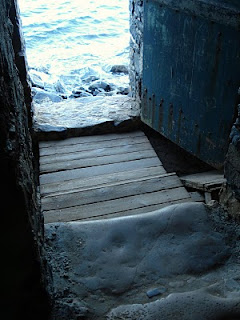
Goree is enchanting despite its dark history of slavery and the ‘door of no return’ which opens onto the waves of the Atlantic. The island is scattered with baobabs which grow at breakneck speed compared to their southern African relatives, and narrow sandy lanes with French names trace their way among quiet pastel houses. Like other visitors, we spent the day exploring, eating fish and rice (many varieties in west Africa), and swimming.

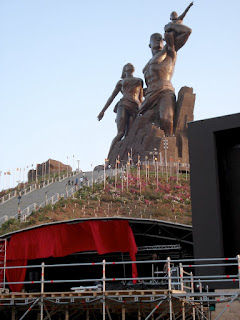
Dakar, meanwhile, is not an aesthetic gem like Goree, but has its own sort of dusty sprawling Francophone charm. The roads are marked with well-worn but brightly painted minibuses, fuel-guzzling SUVs, ancient Peugeots and a fair bit of pollution. On the edge of the city lies the gargantuan and controversial African Renaissance monument, Stalinist in feel but only recently finished. It was built by the North Koreans, and apparently paid for by wealthy local businessmen whom the President repaid with pockets of prime land around Dakar. Nice.


In between meetings editors-in-chief, trying to resurrect my French-in-mothballs, having a dress tailored in the backstreets of the city, and drinking the fabulous green juice of ditakh fruit, I was astounded to hear not only that there was a Zimbabwean Embassy in Dakar but that the ambassador was a *white woman*. I couldn't believe my ears. Next, we heard that there was a sculpture exhibit at the Embassy so we decided to stop by. The ambassador is none other that MDC politician and activist Trudy Stevenson. I surprised the receptionist by greeting her in Shona, and it wasn’t long before both the ambassador and councilor came downstairs to meet us. I don’t think they get many visitors, let alone Zimbabwean ones, so we received a warm welcome.

As it happened, my Dakar colleague used to work as a presidential aide, and accompanied Senegal’s President Wade to Zimbabwe in 2005, where he took part in discussions about land reform with Bob. The Zanu PF entourage apparently took a rather horrified step back when President Wade appeared for the gala dinner with his white wife on his arm. Someone actually asked, 'So did people know that Wade was married to a white woman before they voted for him?'.


Anyway, I do think it was a crafty move of Bob's to send dear Trudy quite so far away whilst simultaneously fulfilling his ‘unity government’ obligations – and of course ostensibly demonstrating his non-racism to the secular and multicultural Senegalaise and their white First Lady.

I am already looking forward to my next visit to Dakar, and perhaps dinner with les Zimbabweannes…


Wednesday, October 27, 2010

Notes from Home

Late September in Harare. The traffic lights don’t work, but the drivers figure it out. The roads near the airport are dark and busy, crammed with commuter taxis, and a smog of vehicle fumes hangs on the early evening air. Harare is like any other third world city, apart from the fact that this scene would not have existed 18 months ago. Zimbabwe’s economy is starting to work again; it is retreating from the precipice of uncertainty that has gripped it for a decade.

We return home, where my mother has been doing some dramatic re-landscaping of the back garden. The flat-topped acacia that they planted over 15 years ago looms enormous and statuesque, with a full orange September moon rising softly behind it. There too the Lonchocarpus capassa that I planted from seed when I left for India. I believed that it could grow in completely the wrong geo-ecological zone, and somehow it did. And my dad’s Erythrina, with its heart-shaped leaves and red-bead pods. My parents joke about the garden’s resident birds being totally disoriented by the changes. The next day I simply sit on the verandah to be.


My time was short but we managed to squeeze in some wilderness. We drove five hours to Kariba, and then another two down unmarked dirt roads to the unsignposted Gache Gache Lodge. Needless to say we were among the rare visitors who arrive by road rather than by boat and, given the signposting situation, ‘twas a surprise we arrived at all.

En route, the country’s agricultural heartland – Chinhoyi, Karoi, Banket and surrounds – lies empty and full of weeds. Of thousands of hectares of land that we pass, at the start of the farming season, only one field was being prepared for planting. Now that the party has figured out how to get-rich-quick through the country’s diamond wealth, it seems there is much less impetus to bother about agriculture. What lies beneath the soil is currently what beckons. On the positive side, fibre-optic cable is being laid down the Chinhoyi road. Yes, that’s right – fibre-optic cable – as in, the internet. This can only be a sign of an economy starting to tick again, like other small indications of confidence: shopping centres in Harare repainting their shopfronts and our local municipality collecting waste for the first time in years.

We laze at the slightly run-down lodge on dusty furniture to take in the warm expanse of Lake Kariba and the start of the dry season. A group of black Zimbabweans is having an extended visit because, having stopped off for lunch, it seems that their houseboat has forgotten about them. Every sandbank markets a 12-foot-plus crocodile, and there is a pod of hippos yawning in the water not far away. Parked at the jetty is a houseboat that used to belong to the Rhodesian government -- named Janet after the wife of Ian Smith, former white minority prime minister. I sunbathe on its deck, marvel at the ironies of history, and earmark the moment for my postcolonial travelogue.


The following day we take a late afternoon drive through the surrounding bush and its groves of baobabs, some sedentary, some dancing, each ancient. There is not much game about but we have drinks on a cliff overlooking the Gache Gache river and its distant curves. Only if you care to look, in the dust beside and all around us are shards of broken pottery: all that is left from the forced relocation of tens of thousands of Tonga people in the early 1960s to make way for Africa’s then-largest hydroelectric dam and an accompanying string of national parks. No surprise that some lions – the creatures in which powerful ancestral spirits reside – take this opportunity to start calling from several kilometers away, making themselves known to us.

A few days later I return to London for the first time in nearly ten months. It is a little more foreign than last time, but the sensation soon passes. I savour the chance to walk long and freely through familiar streets and parks. Wearing a coat is an enjoyable novelty. The damp gathers round the bases of trees just like it always did; London is as it should be.

Tuesday, September 7, 2010

Many Different Worlds in Jozi

In the midst of a strike being carried out by 1.3 million people across South Africa, including nurses and teachers, I find it extraordinary that my day-to-day existence is not at all affected. Such is the reality of a divided society where those in the private sector economy of northern Johannesburg lead a sheltered existence. Meanwhile over 50 premature babies have been abandoned by nurses; several mothers have lost their babies in childbirth, or simply been turned away from hospitals; and funeral businesses have brought work to a halt because Home Affairs workers are simply not around to issue death certificates.

Photo credit: News24

Meanwhile regular South African pastimes such as rugby matches continue. Thousands of free tickets to last weekend’s match against New Zealand were given away in high-density historically-black areas such as Soweto, in the hope of drawing more blacks to the matches. But apparently many of the recipients simply sold the tickets instead. At the same time, parts of Soweto defy outsider assumptions. A colleague who watched the game on Vilakazi St in Orlando West was a bit disappointed that he hadn’t really felt the ‘township vibe’, commenting that he could have been anywhere in Sandton.

Not so for a recent Saturday that I spent in Soweto, not forgetting that Soweto is basically a city in itself, with significant socio-economic stratification. A friend of mine is writing a doctorate on the political economy of waste dumps; her research assistant is from Mofolo, and between them they know a lot about the wider area. Along with a visiting architecture academic, we travelled to the far south-western corner of Soweto, to the informal settlement of Protea South. To give you a sense of the scale of greater Johannesburg, Protea South is 50 kilometres from where I live on the northern border of the city.
There is some running water in Protea South, but no sanitation. Some of the porter toilets are communal, but many households have their own which they clean themselves. Hand-shaped charcoal bricks lie in the sun to bake – it’s the first time I’ve seen this kind of fuel. In Protea South, one can buy a shack for 1500 rand (200 dollars). Consider the extraordinary contrast with parts of Sandton (Sandhurst, for example), where one can buy a mansion for upwards of 20 million rand (2.75m dollars). I’ve even seen some advertised for 50 million.


Yes, Johannesburg is many different worlds. I am regularly humbled by people that I meet, or stories that I hear, for example, about the Zimbabweans who are putting themselves through university on waitressing wages. Leaving Sandton at about 11pm the other evening, I stopped to give a woman a lift. There was something about her that seemed quite desperate. She was trying to get to the northern township Diepsloot. In the absence of a decent public transport system, travelling by minibus taxi costs to and from Sandton for work are 50 rand (7 dollars) a day. Even on my salary I would consider that a high transport spend – and it is no doubt a ridiculously high proportion of her monthly wage. The possibility of her ever accumulating enough funds for basic economic security is virtually non-existent. She will continue to live hand-to-mouth.

So my day-to-day life is full of contrast, wherever I choose to be open to it.
This evening I sit in Cape Town with a Czech colleague and his Sri Lankan friends. We have such different life stories. I listen to how he grew up under communism in an 800-year old Czech town that was razed to the ground in the interest of coal mining, and how the snow used to turn grey within a day. And I tell him about growing up in a national park in Zimbabwe with pythons and lions in the back garden. Meanwhile, our Sri Lankan dinner partner tells us about arriving as a migrant worker in Hillbrow, Johannesburg: he was robbed 8 times in his first month, and early one morning came across a half-headless body in the street on his way to work ….at which point he decided to move to Sandton.

Culinary Delights

At first I dismissed the Bryanston Organic Market for being too all-sorts-of-things for me. I looked down my anthropological-exotica nose and thought: too middle class, too orderly, too controlled, too…boring. But that was before I was converted to eating dosa and uttapam every Saturday lunchtime – possibly my favourite Indian food - cooked by a guy from Bangalore who works for an ayurvedic medicine company during the week, and is a chef on Saturdays. So nowadays I show up at the market almost religiously.

Last weekend the dosa chef invited me to the India Day celebrations in Randburg, patronized almost entirely by the Indian expatriate community. Apparently there's a big divide between the Indian expats and the South African Indians. The crowd was substantial, even late in the day, and there was much singing, dancing and freshly cooked cuisine. The white faces in the crowed were few, though needless to say I met more random internationals, this time an Italian and a Korean who both work for the UN. Social life continues to be varied and interesting, and good food seems to be at the heart of it. I recently attended my first vegan-rawfood dinner party in Oaklands, catered by an American (who also pursues her culinary passions part-time) whom I met at a talk by Nobel Laureate Wole Soyinka. The food was outstanding and you would never have guessed it was all raw.

I’ve been back to Narina Trogon restaurant in downtown Braamfontein for a birthday-cum-salsa party, for which I caught a lift with a Japanese man and a Guyanan woman who live round the corner from me. Who would have guessed Wisteria Lane housed such diversity? I’ve also been downtown to Arts on Main a number of times now, where the canteen offers a tasty well-priced brunch in close proximity to William Kentridge originals. More importantly I’ve discovered that the nearby Malva CafĂ© has the best brownies in Jo’burg, followed closely by those at Moema’s in Parktown North. Perfect for break-up blues.

Nor should I forget the dinners that I’ve been treated to by Piers of Daisy Street, who is a straight-talking general rockstar with the ability to throw together a wonderful meal at short notice. He’s a particular fan of organic ostrich, and has persuaded me to step out from underneath my mostly-vegetarian umbrella on one or two occasions. In fact he even managed to entice me to eat slow-baked lamb at a dinner party hosted in old-money Dunkeld with a lawyer-artist couple in a spectacular dining room decked out in black-and-white tiles, stripes and mirrors. Twas delicious.


One last culinary mention: I went walking and basking by waterfalls in the Mountain Sanctuary Park in Magaliesburg, for which Mel provided trail mix. Mel is Canadian, so obviously she was responsible for the trail mix, but this mix had a magic ingredient which southern African trail-mixers have thus far overlooked: M&Ms. Those who’ve known me a while know that nothing featuring M&Ms will be overlooked by this particular foodie.