Tuesday, October 23, 2012

The Common Soul Shines: Mysore

Each morning I rise at 5.30am and get ready within a few minutes. It is still dark as I leave Door No. 1472, 7th Cross in the neighbourhood of Krishnamurtypuram, Mysore. It is one of the few quiet times of the day, for people in India are busy most hours, and God is everywhere, drawing prayers from all sides, all corners, all minutes. Some mornings the Muslim call to prayer wakes me first at 5am, other time the devotional chants are already underway at the nearest Hindu temple. 

I walk 5 minutes to reach my yoga shala, situated at No. 1317, 3rd Cross, passing the Shree Ladies Beauty Parlour and Surya Medicals on the way. This is usually a very quiet time of day, like I said, but there is a small tearoom already open, where the working men on scooters and motorbikes stop for a quick idli and hot chai. 

Upstairs the shala practice room is already getting warm and busy as the students from around the world stretch, meditate or say prayers.  From the rooftop one can see Chamundi Hill, the place where the goddess Chamundeswari slew the demon Mahishasura (after whom Mysore is named) in a battle that lasted for nine days and nights. These nine days came to be called Dussehra, which celebrates the victory of good over evil, as well the power of women more broadly.


The temple on Chamundi Hill - the original shrine dates to the 12th Century

Our teacher has already been up since 3am when he does his own meditation and practice before turning his attention to us. Each morning begins with an opening prayer chanted in Sanskrit as the clock strikes 6am:

Jeevamani Bharajath Phana
The common soul shines like an emerald on the head of the snake
Sahasra Vidruth Vishwambara
Which has one thousand heads and is all pervading
[and the prayer continues...]  

Mysore-style ashtanga yoga is not led but only supervised by the teacher -- each student must remember and implement the sequence of some 60 poses and their variations, in the correct order, preferably with no memory aides.  The students are at different levels, and several do apparently impossible contortions that I can only dream of.  Our teacher circulates the room to improve the students' positions, stand on them with his full body weight, or even pick them up and swing them around, sometimes shouting instructions across the room: 

"Hello!  HELLO!!"
"Head up. Head up! UP!! Eyes! Knee to floor! No, floor!! RELAX!!!"
"Tssst!"
 
Around 8am, as our vigorous practice is coming to an end, the fruit and vegetable sellers start to steer and ply their wares up the street. We know their voices and their individual hallmark cries by now, even though we don't know their faces.  Somewhere next door is the sound of running water and a woman beating her laundry with gusto.  Charcoal fumes drift in from nearby kitchen stoves.  The train horns blare in the distance, on their way to Bangalore. By the time we emerge, sweaty and stretched to the enth degree, life in the residential world of Krishnamurtypuram is all a-bustle.

If you take the first right at the construction site and turn left at New Globe Tailors, there is a one-room one-man laundry operation where you can drop off your laundry virtually around the clock. Just down the road is the Vijay Motor Driving School, as well as a printing press whose machines spin till late. Next door to the yoga shala is a classical dance teacher whose teenage students are busy preparing for their exams, still practising at 9.30pm at night.  Amidst all this, residents go about their daily lives, cows wander by and keep the road adorned with cowpats, and boys play cricket in the street in the afternoon. Collectors of alms come and go.   

People here, like elsewhere in India, are enterprising: homes often double up as business premises.   I pay 30 rand/USD $4 a night for my room at the home of a woman who must make a small fortune cooking delicious lunches and giving cookery lessons to word-of-mouth foreigners who appear in droves to sample her cuisine.  In the morning the small kitchen is by far the most crowded part of the house, comprising the three ladies preparing lunch (for up to 30 people), the domestic worker, two small children, the cat, and the two Czech yogis (my neighbours upstairs) who are cooking their customary sizeable pot of oats.
My simple room with the hardest bed in India is upstairs at the back, with shutter windows overlooking the Dr Ambedkar Park on one side, and into the courtyard on the other.  The courtyard has a small altar and the greenest-leaf-tree I've ever seen, and below the ladies of the house wash, clean, sort and dry, in the way that women do everywhere. It is cool and clean, if not messy. To reach the courtyard, and thus the toilet and bathroom (each of which has a blogpost-worth of damp individualities) requires descending a steep metal ladder which would avert even the most avid of night pee-ers.


Many of my meals have been had at the no-frills Hotel Mahesh Prasad Veg Restaurant, a fast-service diner situated next door to a chemicals shop. Mahesh Prasad has a cashier who prides himself on the speed at which he can return your change, and turns over 1000 customers a day. Now that's business for you. The menu is highly classified according to times and types, the full rationale for which I haven't yet figured out, but one's ordering has to be carefully done with these many timings in mind:

Tiffin Select 3.30pm - 7.30pm
Dosa            7.30am - 12 noon; 4.15pm - 6.30pm
Chat            5.30pm - 10pm
Chinese       5.30pm - 10pm
North Indian 7pm - 10pm
South Thali  12.30pm - 3.30pm
North Thali  7.30pm

The Mahesh kitchen, which you pass through on the way to the loo, is another world -  New York speed, Bombay heat and a lotta workers.  You can get take-aways at the 'Parcel Counter' where your food will be expertly wrapped in plastic and newspaper, secured neatly with string.

It's not all romance, of course.  At least one of the famous yoga schools that I enquired with in person was unwelcoming and exclusive, leaving me with the impression of being a bizarre mix of a business and a cult. The yogis (practisers of yoga) are often territorial and competitive about their teachers, affiliations and the correct way to teach/study; they remind me of rowers to the extent that they can talk about nothing besides...yoga.  There is not nearly as much humility as I was expecting.  And many of them prefer to stay in what I call the 'yoga cocoon', ie. only in the safe comforts of places frequented by foreigners, offering Western health food, smoothies and bountiful quantities of spirulina.  The local economy has adapted around these demands of course, particularly in the neighbourhood of Gokulam: the couple who sell silver jewellery, incense and spirulina from home; the man who sells overpriced rooftop lunches; various Ayurvedic masseuses; and best of all, the family of dentists who sell chocolate on the side (!) 

Today is the 9th day of Dussehra, with preparations and celebrations already well underway for tomorrow, the festival's apex. Today is celebrated with the worship of the implements and machines that are used in day to day life and which help people earn their livelihoods. This means that everything from bicycles to buses (including the computer I'm typing on right now) is decorated with banana leaves and yellow flower garlands. Till next time...

Saturday, October 20, 2012

Earth and Water: September in Zimbabwe

The Gairesi cottages are only some 12 kilometres from the Mozambique border in the eastern highlands of Zimbabwe. Near here, in 1975, the young Mugabe was smuggled across the border by Chief Tangwena and his people. I wonder who and where the Rhodesian patrols were. It is worth including this excerpt below from Edgar Tekere's autobiography which comments on the significant role of Tangwena's wife, the 'small woman', in facilitating the safe escape:   

"We stayed in the forest, looked after by Tangwena’s wife. It was misty with a light drizzle, and so she was able to light a fire to cook for us, without smoke being seen by our pursuers. Mbuya Tangwena called on us to join her in traditional prayers, and take snuff, as is the tradition in Zimbabwe. Tangwena was waiting for his wife to give the signal for us to move. She was a spirit medium, a host to Sekuru Dzeka Tangwena, her father-in-law. On the second day, at around seven in the evening, Mbuya Tangwena became possessed with the spirit, and instructed us to leave. She told Chief Tangwena to take us to Tangadza, another sub-chief of the Tangwena Dynasty, who was living on the Mozambican side of the border. She ordered her husband to take us by the most difficult path, at which he demurred, but the old lady told the great chief, “You just do it, or these people will be caught.” It was amusing to see him defer to this small woman."

We are staying in a quiet valley, just us and the caretakers here, and the rush of the Gairesi river below. The walking is idyllic and the water is crystal clear, strong enough to swim on the spot. Up on the hills there are scattered hamlets and homesteads, though not many. From there, nobody's business is private, because the landscape is open, ceding far and wide views, including of the paths by which the villagers get around in these parts. There are no other vehicles besides ours. Most people seem open and greet us in a friendly fashion. They have a good laugh when they see me going for a run. The caretaker here is confident and engaging. This morning she asked me about my work, and pushed a stray lock of hair back behind my ear in a sisterly fashion. It was a gesture that would never (or very seldom) happen in South Africa between (black and white) strangers. 

This morning we drove through the hills to The Waterfall, as it is known. On an old map I spotted markings for ruins and ancient terracing, so I went off to explore. In an open grassland, the dense thickets of trees are an archaeological giveaway: trees have taken root in the damp cracks between stones that were carefully walled here in the 18th and 19th century, perhaps earlier. They are thickly grown over with creepers and vines; it feels slightly eery being there in the midday shade. The Nyanga stone pits - now just sunken depressions in the earth - are well known by archaeologists. The effort that went into their building was significant. I found four pits in total, all in close proximity, and no doubt there were more. Significant research has been done on the pit structures, and though there is still debate about their function, cattle kraaling seems to be the best founded. 


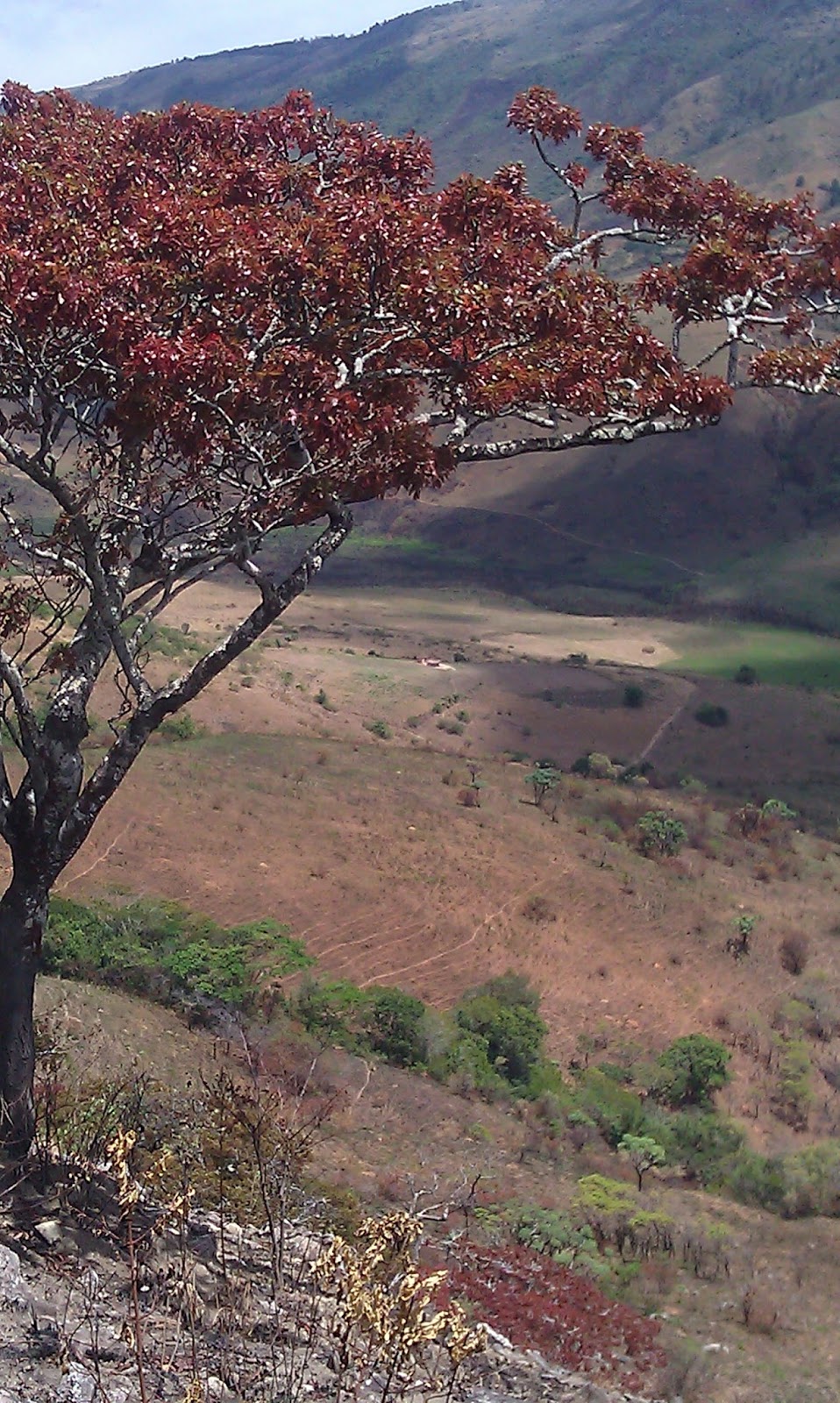
I clambered up further. The hill proffered quintessential Zimbabwean scenes: isolated homes on rolling hills framed with spring msasa trees, their dark copper satin leaves so smooth and fine to touch that you wonder how they will survive the coming heat. And behind, the rocky granite debris with its lichen fields. From there one can see everything that would have needed to be seen: the scale of the clan's cattle wealth, or perhaps its dimunition in hard years; the approach of enemies or kin; beasts of prey, for lion are certain to have been many in those years; fire smoke on the horizon; and the coming storms. 


Our next stop was much further north in the country: Chitake springs near Mana Pools, for the annual wildlife game count - an activity with a primarily white subscriber base and apparently more social than scientific in nature. After a flurry of unpacking, repacking and food preparation in amidst Harare power cuts, led by my camping powerhouse mother, we set off for Chitake. Our 40+ degree campsite was on the edge of a steep cliff overlooking a thread of stream formed by the only springs in a 9 kilometre radius.  In true white Zimbabwean fashion, we combatted the heat with the indefatigable cooler-box-at-large (that is, several filled with ice, cold water, beers & Coke, which had to be shuffled from patch of shade to patch of shade in continuous fashion).

Chitake is well known now for being an 'extreme' wildlife experience, and it certainly lived up to expectations. The first night, after dinner, some 30 elephants came down in the almost-full moonlight, many of them babies or young with the first stubs of tusks. During the hours of sleep, all sorts of sounds of the wild: lion, elephants, hyena and then the bellowing of buffalo. Around 2am we emerged from our tents and, under the cover of darkness with the moon having sunk low, watched more than 40 buffalo nervously flocking around the water below. Quickly and with no warning, a group of 7 lions swept down the bank and across the sand. An extraordinary stampede up the steep bank opposite followed, the air so thickly drenched with fine dust and dung that we could see it even in the dim light. The fear and panic was pulpable. One lone animal was left behind, not knowing what to do. Yet it seems to have escaped, for moments later the lions had made their kill. We could not see it but the remainder of the night was filled with the sounds of meat being devoured and snarled over. By early morning the only sign of the carcass was a stretch of dark skin and a few tossed bones. This is nature in the raw. 


The next night, two lionesses passed the camp 20 metres away as I stepped out of the shower tent. Me and them. We saw each other but their intentions lay elsewhere. In the morning their spoor, and that of others, showed that they had passed several times along that same close-by track. The remainder of the weekend we were swept with wind and dust, a layer of Zambezi Valley earth deposited on our faces even during sleep.

Oh this earth, this water.

Friday, September 21, 2012

Origins: From Orania to Taung

We rolled into Williston in the Namakwa Karoo in time for sunset, some 540km after leaving Cape Town via Ceres, Citrusdal and the abundant spring flowers of Nieuwoudtville.


If dry and dusty describes this former Rhenish mission station during the cool winter, then hell knows what it’s like at the height of summer.  For a particularly modest sum we rented a substantial 3 bedroom house for the night – Die Bankhuis, built in 1913 – along with its creaky wooden floors, enormous old fashioned bathtub and generous stoep.  The landlady looked worn out and explained that the village residents were still recovering from a festival a week earlier.  We figured that if things move slower in Williston than Jo’burg then maybe people take longer to recover from their hangovers too.

We were the only customers at one of two local restaurants where most dishes come out the freezer except for lamb, which grows on trees in these parts. Or shrubs, more likely.  As part of our plot to try visit Orania in the Northern Cape Province the following day, we innocently asked our teenage Afrikaans waitress about it, all the while aware of Orania’s reputation as a 100% white stronghold for right wing Freedom Front voters and Afrikaner separatism. 

We think she pretended not to know about it (and indeed there are plenty of Afrikaners embarrassed by this sector of their brethren), though we couldn’t say for sure.  Perhaps she was grappling with how on earth to explain to us that as a multiracial pair, we wouldn’t be welcome there.  Either way, she returned later on to say that she had gleaned some Orania information from her female relative in the kitchen.  In Orania, she declared, there was a giant koeksister monument to visit.  J. and I looked at each other in amused disbelief.  Was she for real? A colossal history of proud self-determination, racism, self-reliance (selfwerksaamheid) and ethnic defiance, an African place where no black people are seen, all subsumed to South Africa’s syrup-sodden national dessert delicacy?

Later, however, we realized that The Koeksister (now with capitals, note) was our green card to Orania.  Perhaps the waitress was actually being uber-strategic. You see, we needed a reason to go in.  The signs on both sides of the road state that Orania is private property.  So we stopped at the garage and asked a youth with a thick accent for directions to The Koeksister.  He seemed to think the request reasonable enough, though an older tannie with a dried-peach face (sucking on a lollipop, nogal) pottered over to us with curious suspicion and asked what we were looking for.

The settlement itself is small, apparently some 300+ families, probably reminiscent of a lower middle or working class neighbourhood in the rural United States.  Small pre-fab houses with caravans or bakkies outside.  Neat roads and verges, and a billboard map at the entrance. Orania has its own credit union and even its own currency, the Ora. Their mayor is the son-in-law of former apartheid Prime Minister Verwoerd. All jobs, from management to manual labour, are filled by Afrikaners only. Apparently parties are not allowed, but they are progressive environmentalists, and we saw a straw-bale house from the road.


It was eerily quiet that Sunday afternoon.  Do people just sleep after church? Not even the smell of a braai.  (Are braais categorized as parties?) We soon found the ‘giant’ Koeksister, which turned out to be disappointingly small.   But it was at the foot of a hill where the metal busts of five unnamed but easily recognisable fathers of Afrikaner nationalism stand in a semi-circle.   Their beady guiding eyes are fixed on the figure of a small but defiant boy rolling up his sleeve to in a gesture of resilience, and perhaps in preparation for combat.  Nearby, the Orania flag flies high with its Dutch-origin colours of orange, white and blue.  Both of us were nervous to even be there in the first place, let alone to set multiracial foot on an exposed monument hilltop where we’d make an easy target for any half-decent extremist marksman.  But J. loudly declared that her ancestors had been there first, so up the hill we went.  Definite sighs of relief on the way out.

If Orania wasn’t quite enough for one day, then Taung in the North West province was an additional unexpected eye-opener.  During the journey towards Taung, we couldn’t understand why this site of the famous 2.5 million year old Autralopithecus Africanus ‘Taung Child’ hominid discovery in the 1920s, wasn’t mentioned on any road signs.  None. Anywhere.  We drove through the irrigated lands of Hartswater where olives, pecans and grapes grow in abundance, thanks to a crazy idea that Cecil Rhodes had back in the 1880s about irrigating a semi-desert with hand-built canals using family labour.  Just after sunset we finally drove into Taung -- and realized that this was no 3-street village frequented by amateur paleoanthropologists, but rather a sprawling and unlit township featuring one Kentucky Fried Chicken, acres of litter, and rows of small brickface RDP houses. Taung used to be part of Bophuthatswana, the former bantustan ethnic homeland for the Tswana people. 

We followed the one and only guesthouse sign that took us winding down increasingly dark and dusty roads.  It was the second time we were nervous that day, albeit for different reasons.  Needless to say, the guesthouse wasn’t in action that night.  After a few wrong turns and managing to avoid the stray dogs and jaywalkers, we found a second guesthouse where the hustling hostess took quick note of our Gauteng car registration and our middle-class-rainbow-nation vibe, and promptly upped her prices for the night despite the broken shower.  We didn’t have much choice, but complained to her and amongst ourselves over the course of the next 12 hours.  A township layover wasn’t exactly what we’d planned, but we both agreed that a potentially dodgy township was infinitely preferable to a staying any longer with the white extremists in Orania.

The night passed uneventfully and we left early next morning for the disused limestone quarry hominid site, which is about 15 kilometres out of Taung in a rural scrubland setting.  And what a remarkable site it is.  Beyond the gouged-out quarry pits and the deserted workers’ hostels lies a wide gorge sporting ancient cliffs, dotted with rock pools that nestle amidst a network of underground tunnels and lakes.  With the assurances of our guide, I pushed aside my claustrophobia and lowered myself into a body-size hole in the corner of a cliff.  Underground it is warm and moist.  A series of extraordinary stalactites is revealed, each as thick as a pillar.  If you listen carefully, there is a soft but definite drip-drip of water.  Apparently all sorts of people of faith (including Muslims and Hindus) come here to pray, make offerings and collect sacred water.

Above ground, a pair of nesting Black Eagles treated us with a magnificent fly-by series, showing off their two-metre wingspan – in fact the best eagle sightings I’ve ever had.  They mate for life, unlike most humans. Swallows dart and nest in the cliffs where the limestone-pale is made even whiter with guano. Best of all – camping is free by prior arrangement.

The remainder of the drive back to the city of gold via Potchefstroom is soulless if not depressing.  The townships become larger and poorer, sprawling as far as the eye can see, the sight of mine dumps and fancier cars more regular.  The odd gumboot is abandoned on the roadside.  This is in many ways the landscape of the recent Marikana mine-worker tragedy – the worst state violence seen since apartheid, which took place just 1 hour and 37 minutes in a north-west direction from Jo’burg.  It’s timely that a report on South Africa’s rich was just published this past weekend:  whilst the Marikana miners are protesting about their 4000 rand (US$ 484) per month salaries, the first half of 2012 saw 640 South Africans buy Porsches in the first half of 2012 (a 17% increase in sales) and 513 buy Jaguars (a 99% increase in sales). From Orania and Taung we learn something about this nation’s origins – but its destination feels most ambiguous right now. 

[With thanks to J. for her photo of the Orania boy]

Good Hope and the Cape

Self-renovation has indeed been in need, and so a late-winter road trip to Cape Town, known as the Cape of Good Hope in the 17th century, seemed appropriate.  A Canadian acquaintance spontaneously agreed to join me and we hit the road before sunrise for the start of a 3-day, +2400km journey south. 

In Bloemfontein we visited the Afrikaans Literature Museum, which has a outdatedly-curated quirky collection of beautiful antique writing desks, photographs, paintings, letters and other memorabilia.  Wall biographies of liberals Andre Brink and Ingrid Jonker are appropriately nestled together in the furthest-away corner.  We also managed to swing a free private 30-minute tour of the Bloemfontein High Court at no notice, after making friends with a security guard downstairs and avoiding a visitation of Alsatian police dogs.  

Thereafter we took less of a beaten track.  A few hours later we arrived in Richmond, known as the ‘literary jewel of the Karoo’, and for good reason.  It’s a two-street village with a church (that goes without saying for any settlement in the Karoo) and an extensive, atmospheric second-hand and collectibles bookshop.  We zoomed in late on a Friday afternoon, crossing fingers that we weren’t going to miss out on bookworm time. I couldn't resist another Doris Lessing, this time Martha Quest.


You only need to have a conversation with one resident in the bookshop to ensure that the whole population knows your business in under an hour. Sitting down for dinner at the only restaurant, the manager was quick to say, ‘Oh, I hear you’re from Zimbabwe’. So was he, it turned out. It was low season, so the guesthouses were either closed or virtually empty; we were the sole occupants at ours. We went to grateful sleep that night on crisp sunshine-dried sheets ironed by the coloured women who were gossiping in Afrikaans next door in the kitchen until late.

Another early start the next morning took us on a smaller road through the Valley of Desolation to Graaff-Reinet, where the price of a cut-and-colour at the hairdresser is exactly half of what it costs in the northern suburbs of Johannesburg.  Pity I didn’t have time to take up that opportunity.  We visited Reinet House, a former Dutch Reformed Parsonage dating to 1812, which has a beautiful mill-house adjoining the back garden.  Nearby, the Old Library museum gives insight into slave histories and charts the life of anti-apartheid struggle activist Robert Sobukwe, for whom Graaff-Reinet was home.


Heading into the Eastern Cape, we made a special diversion to Nieu Bethesda, a settlement established in 1875 but which only got its first electricity in 1993.  We were egged on even further when the local tourism officer described its main attraction -- the Owl House -- as ‘pretty weird’.  Pretty weird turned out to probably be the highlight of the journey. Helen Martins, the woman who lived in and created the Owl House was a recluse, twice divorced in a tiny, conservative and isolated society where – unimaginably - she had stopped going to church.  In her fifties and the '50s, she began re-creating her living space with crushed coloured glass and gave life to some 300 glass and concrete figurines, including owls, mermaid, wisemen and more.  She committed suicide in 1976.  It is a fascinating and tragic story, which in part inspired Athol Fugard's Road to Mecca. I’m looking forward to learning more.


From Nieu Bethesda we had a long day’s drive south to Plettenberg Bay, arriving after dark. We tried to take a shortcut from Uniondale to the coast but after about 15 minutes on a bumpy dirt road, I stopped to ask advice from an elderly man who was carefully driving an elderly bakkie behind us. “I don’t want to be a killjoy”, he said in the sincerest fashion, “but I really don’t recommend this route. You’ll damage your car.” And so we had to travel further east first to Jourbertina, adding an extra triangle to our journey.

The popular Garden Route deserved more time and exploration, but I was surprised at how settled and developed it is.  We dipped our feet triumphantly in the southern oceans for the first time at Wilderness before heading through vast fields of yellow canola fields to Hermanus in search of whales.  Sure enough, it only took 20 minutes to glean a some whale-surf sightings, but then it was time to push on again and get my co-traveller to her flight back to Jozi.  

And what thereafter? It’s easy to seclude oneself in the salubrious parts of the southern peninsula and indulge in exploration: in Noordhoek with the Ugg-wearing yogis, where I attended classes taught by a former Israeli Olympic marathoner; in Muizenberg with the walkers and surfers (including the man who’s running 3000km along China’s Mekong River); in Kalk Bay at the cafes and with the artsy-enviromental types. Happiness came in vegetarian food and lemon cupcakes at the Tibetan Teahouse in Simons Town, cycling along Chapman’s Peak on an early spring day in sun-and-blue, the heavenly flourless chocolate cake at the easy-to-miss-apart confectioner’s in Fish Hoek, and hiking around Cape Point surrounded by the extraordinary biodiversity of the fynbos winter flowers.


Ah yes, it can be a bubble in these parts, broken occasionally by the Zimbabwean immigrants, often easily identifiable by their name badges in restaurants and shops (there’s only one country that Learnmore could come from) or by snippets of Shona regularly overheard.  There’s the girl with tears in her eyes when she talks about home and her mother; the woman who hitches a lift with me from Scarborough to Masipumelele township; the man who is about to take his dead brother’s body on the long journey home for burial.  This far-end-of-Africa has been a source of Good Hope for many during uncertain times to the north, and for these few weeks I guess I am among them.

[With thanks to K. for two photos included here]

Monday, June 11, 2012

Nowhere Anymore: From Kariba to the Queen's Jubilee

In the immigrations queue at Heathrow, an American oil worker fresh off a Mozambican rig asks me where I'm from. I have to take a genuine pause. "Nowhere anymore, really", I say, without further elaborating. "Oh dear", he says. He's on his way back to the US because his son has been in an accident and sustained serious head injuries.

It is a public holiday and the final day of the Queen's Diamond Jubilee celebrations. There are only about 5 people on the Underground that morning, and 4 of them are wearing coat tails and fancy hats, on their way to St Paul's Cathedral. The British have an amazing capacity to get completely carried away by public displays of, well, Britishness. Formerly Empire.  They've had centuries of practice, I suppose. Based on the TV footage, it appears that the vast majority of celebrators were white, though the BBC was sure to re-play several times a short interview with a Muslim girl in a British-flag-hijab, and I catch a glimpse of a Sikh man in the crowds.  I do hope they haven't exhausted all their ceremonial enthusiasm before the Olympics.


Later, in the cab with my Nigerian colleague, the white English working-class cab driver asks us where we're from. "Zimbabwe, originally", I say. "And my colleague here is from Nigeria".

Him: Oh, Zimbaah-bway.  Did that used to be Rho-dee-shah?
Me: That's right...
Him: What does Zimbaah-bway mean anyway?
Me: It means 'houses of stone', from 'dzimba yemabwe'.  After the historical Zimbabwe Ruins.
Him: And what about Rho-dee-shah?
Me: Oh, that was named after Cecil John Rhodes, the British coloniser.
Him: Well at least Zimbaah-bway means somefink.  Rhodee-shah don't mean anyfink, does it?  It's just a made-up name.
Me: I guess that's right...

Then the driver addresses my colleague:

"Nigeriaah, eh. D'you eat shaki then?"
T. thinks he's misheard, because he can't believe that a London cab driver would know what shaki -- the Nigerian tripe dish --  is. The driver waxes lyrical: "Yeah, me friend's mum's always sayin', 'Shaki's good for ya, shaki make you strong!' But once you know what it is...!"   T. chuckles in disbelief.  Welcome to the world in one city.

Speaking of origins, I returned to Zimbabwe recently. It was a genuinely interesting and contented visit. Our small diaspora family came together from three countries to celebrate my mother's 60th birthday and my father's successful open-heart surgery. We were surrounded by old friends that day in the winter afternoon sun -- all those who have stuck it out these past 12 years, despite everything. The generator hummed in the background (12-16 hour power cuts are still typical), and the lights, oven, kettle and other electrical appliances were carefully coordinated so as to avoid any untoward power failures that would affect the catering.  

The same week, I attended the Harare International Festival of the Arts for the first time. A few days earlier on the plane, I was filled with juvenile excitement when celeb musician Oliver Mtukudzi sat down next to me. At the Festival itself, a host of old friends and teachers appeared, most of whom I had not seen in well over a decade. Many had returned to Harare specially for the occasion.  

Turkey, England, Australia, the United States, Spain, South Africa: people have been everywhere, in exile of various kinds, carving out lives for themselves, bettering themselves however they can. One of the pianists, once an intimidating older star-musician at my primary school, and now the organiser of an annual music festival in a Turkish fishing village, gave a tear-jerking Beethoven performance in the Dutch Reformed Church downtown. I remember meeting her teenage MDC activist brother on a plane; I was struck by his apparent fearlessness. He was later arrested multiple times and tortured and, unsurprisingly, left the country afterwards.  Yet still his sister is willing to return.

Also that week, we drove to Kariba, accompanying my mother on a work trip. There was more traffic on the roads that I've seen in many years, including numerous heavy trucks travelling to and from Zambia. The farmlands along the Chinhoyi-Karoi road are so overgrown and disused that within a few years no one will guess that there were ever any farms. According to a senior representative at National Foods Zimbabwe, the country now imports 80% of its wheat from...the Ukraine. And sourcing it from the Ukraine is 25% cheaper than sourcing it locally. Those stats are enough to make one's head spin rather wildly.


Yet there are other spheres where Zimbabwe has boosted its exports. In Kariba, for example, we visited the largest crocodile farm in the world. They supply the leather for Hermes' luxury designer handbags -- we're talking circa £6000 per bag and upwards. The farm's new HR manager had just returned to Zimbabwe from a decade in London, where he worked at a leading software firm. A bit different to crocodiles.

The following day we attended a graduation ceremony for one the training programmes that my mother's organisation funds. Wives and children gathered to watch their husbands and fathers, soft drinks were had all round, fun were poked at participants in a mix of Shona and English, and afterwards the catering ladies - who probably couldn't all fit in the tiny kitchen at the same time - fed sadza (maize porridge) and fried fish in voluminous cooking pots to some 80 people. The Zimbabwean hinterlands are full of interesting characters, and everyone has a story. One of the trainers, white, in his 60s and fluent in Shona, was born in Botswana, where his mother taught President Seretse Khama's English wife to speak Tswana.

And so ends another few weeks in the postcolony. Nowhere anymore is not too bad - just different.

Tuesday, April 24, 2012

West with the Night

Two years since my last visit to West Caprivi, and my skin has grown unaccustomed to the bites and itches of the field. The names of places and people are rusty on my tongue. It is good to hear Khwedam again. There are more village settlements now, a little disorienting.

The 'creole' camp at Buffalo, my label for the mix of cultures and languages of its residents, is as it ever was. All sorts of familiar objects of curiosity - markers of Friedrich and his determinedly outdoor and individualistic life. No one was there on arrival, so I made myself at home in the open-air clay kitchen, with its view over the Kavango river and its high clouds. I made cucumber soup and coconut dahl whilst an old buffalo, a hippo, two bushbuck and a family of warthog took turns to feed within a hundred metres.


The next day I went into Mutc'iku with a German student researcher for her interview with a local Khwe leader who appears to have made a remarkable recovery from alcoholism. We found the men playing wera (mancala) at Dikwe's Place, the local watering hole, with a spat between two old ladies going on in the background. Business as usual. We made our way to a quieter setting. It was a bit surreal, sitting there in a wretched Khwe courtyard, with the litter, death's-door dogs and chickens scurrying around, the family piecing together a meagre meal, witnessing this researcher, as if watching someone else live my former life. Yet she is more relaxed in her manner, less concerned with 'doing it right' and pleasing everyone, like I was. She will do better.

The grass is high after the long rains; I was unsure of the turning to /'Ui-Sha's house, but I got it right. She was just heading out with the goats and I received a warm welcome. Her beautiful, smart, breadwinner daughter (and my fieldwork friend), whom I saw a week before her death in 2010, is gone, lost to the scourge of AIDS and witchcraft, but /'Ui-Sha looks strong in body and spirit, as she always did. She has planted an even bigger field of maize this season. Her friendly but deranged grandson was there. He's never been the same since the armed rebel attack on Bushbaby shebeen in 1999, still scrawling the name of that fateful place on the outside walls of her two-room government-issue house.

Carol came to pick me up from Buffalo, and we ate solar-cooked Persian biryani by the fire under a magnificent tapestry of stars. On the way back to Katima, we stop at an NGO base in East Caprivi on the Kwando river delta, where one Nadia has recently saved a third pet cat from being eaten by a kingsize python. She eventually wrestled the python into a cooler box. (Rule number two: every white southern African must have a cooler box, primarily for alcohol and red meat, and then also just because you never know when it might come in handy). Meanwhile her hyena-specialist colleague attended to the barely-conscious cat.

From the funny to the sad, it's life and death all the time in this place.

The next morning Carol loaded me into her 30-year old Toyota which gets us curious looks of admiration at the border post, and off I went to Livingstone once again, dodging the potholes with the Rhodesian-Zambians. A Zambian taxi driver crossed the bridge with me on foot, and hooked me up with a Zim taxi driver on the other side. The latter was a Tonga-speaker from Binga, with possibly the cleanest smartest taxi I've ever been in. He has a 4-year accounting degree from a university in Gweru. There weren't any jobs for him afterwards, of course, so he drove second-hand BMWs and Mercedes from Walvis Bay to Zimbabwe through Kazungula (vehicle import loophole, for those in the know, like the Rhodesian-Zambians).

Before heading to the airport and disturbing the immigrations officer from his lunchtime nap, I buy divination sticks at the craft market. They are laid out on the floor across a piece of old newspaper, directly on top of a photograph of Mugabe's face. The seller tells me they mean good luck: it's going to be seriously needed if the rumours about the president's poor health come to bear.

Sunday, April 22, 2012

'Like Bread from the Congo': Katima Revisited

The smoke coming out of the earth catches at the heart: that first sight of the distant Victoria Falls from the air. I'm still surprised at these unexpected moments of patriotism, having left nearly half my lifetime ago. After landing, I crossed the Zimbabwe-Zambia border by foot, breathing in the dramatic whirlpools and rainbows far below the railway bridge. Well-known views, lesser-known emotions. At immigrations, a black Zimbabwean man was taking his two granddaughters to see the Falls for the first time. The official passed a wry comment about his ID card which still said Rhodesia. I came across the bridge last in mid-2008. It was a horrible time in Zimbabwe's demise, the air thick with desperation and despondency. This time, thankfully, it felt more positive.


Transport to Caprivi has a way of just falling into place. Usually I take the Mazhandu Family Bus but this time Carol arranged a lift from Livingstone with some friends of hers. They are white Rhodesian-Zambians with a fighting spirit who have moved from place to place, mine to mine, much of their lives. Now retired, they had lengthy negotiations with the local induna for 7 acres of land down a bush track in western Zambia, on the edge of the Zambezi. Their business card simply gives a latitude and longitude, and 'Upper Zambezi River, Western Zambia'.

We negotiated the potholes of the Livingstone-Sesheke road at some speed, and arrived in the dark. The journey included the only conversation I've ever had where someone has offhandedly referred to the characteristics of bread from the Congo, as if eating bread baked in the DRC was the most normal of things. At bedtime I moved my campbed onto the veranda to enjoy the night air, its moonlight, and its many sounds. The Zambezi river is fast-moving at this time of year, bulging from its northern post-rain tributaries. Rule number one: always travel with your own mozzie net -- you never know when you might need it.


The Sesheke market (also the main photo on this blog) was the first stop of the next morning. It's been some years since my last visit, but I took the transition back to smallest-town Africa like a fish to water. We indulged in chitenge fabrics, dry beans, boiled nyimu beans and eggs, before being dropped at the Namibian border and hitching a lift into Katima Mulilo with the only gay in the village. Katima has grown. Less dust, new shops, more cars on the road. People didn't take much notice of me when I walked into town the next day, crossing paths with a boomslang on the way. (As a child I recall how its very name was as ominous to the English ear as the snake.) I went to the market and unsurprisingly maxed out on more of my favourite goods: chitenges and beans.


Katima reigns in unusual characters with interesting stories, as ever. The local masseuse (yes, imagine), for example, is no less than a natural-medicine-toting missionary en route to Tanzania, on horseback, nogal. They were stopping over in Katima when her missionary father hit two drunk pedestrians at night on the main road. They await his court case. My old trailer home now houses a Scottish fish biologist who has spent the last 30 years in Africa and was just back from a consultancy in Liberia.

The Fish Farm is past its heyday and rather dilapidated, overgrown, unkempt. But it was good to be back in Carol's corner cottage, the birdsong in the early morning is overwhelming (they're certainly not complaining)  and I still feel fond of what was my fieldwork base in 2003-2006. Tatenda has returned from death's door and looks well and healthy on his anti-retrovirals. We dropped off medicine and foodstuffs for Bill, diagnosed recently with advanced cancer. His wife, the ever-resilient Lydia, gifted me with a bottle of her signature homemade lemonade in a Smirnoff Vodka bottle. Change is always in the air, but the Fish Farm friendships live on.

[ *names have been changed]